
Page 22 - Blog
-
Posted: July 08, 2020Read more »
What You Need to Consider When Purchasing Antennas
When buying an antenna there several factors that go into finding the right solution for your network. Without proper consideration, you will not achieve the desired connectivity, which can result in a loss of time and money.
The basic function of an antenna is to take a signal traveling through a cable and convert it to a signal that can travel through the air. The most common applications for antennas are Wi-Fi/WLAN networks, the “Internet of Things” (IoT), and in public safety/first responder systems.
Since there are many different types of antennas, these are a few of the major items to consider before you buy an antenna:
- What is the application?
- What frequency do you need?
- Is there a certain gain or square footage of coverage you need?
- Do you want coverage everywhere, or in at a specific point?
- Which connector types do you need?
Here are a few of the most common questions to help you understand which antenna works best for your
-
Posted: June 28, 2020Categories: Power CordsRead more »
5 Things to Consider When Purchasing Power Cords
When purchasing power cables, knowing what qualities to look out for will help you save time, money, and stress.
1. Plug & Form Factor
Identifying which power cords you need can be confusing. There are dozens of different NEMA & IEC jacks and plugs. The problem is even more compounded when you add-in international plugs. We have created this helpful chart to help you identify which power cord you need.
Another consideration beyond fit is the orientation of the plug. Space-saving right, left, up, or down angled plugs can help you minimize space, promote proper airflow, and prevent accidental disconnects.
2. Length: Longer is Not Better
After deciding which plug or jack (inlet or outlet) you need, you need to decide on the length. This is especially true for data center applications. Excess cord leads causes restriction of airflow, causing cooling systems to work harder. It also takes more energy to push electricity over longer cables. -
Posted: June 09, 2020Read more »
Ethernet Jacket Types 101
Ethernet cable jackets are made from various materials and carry different ratings assigned by the NEC. Let’s run through some commonly asked questions about these materials and NEC ratings to help answer some common questions about which material and jacket rating is used for most installations:
What is a PVC jacket?
Polyvinyl Chloride is the backbone material in most ethernet cable jackets. It is a high strength and flexible material, which makes it a go-to jacket for most ethernet cabling. PVC is the most common material found in the below jacket ratings.
What is a PE jacket?
Polyethylene is most common with outdoor rated jackets. They are good at moisture and overall weather resistance. There is also a CPE jacket (Chlorinated Polyethylene), which is even better at oxidation, weather/UV, heat, oil, and flame resistance. PE is best used for any outdoor ethernet runs, while CPE is ideal for direct burial.What is a CM rated jacket?
Communications Multipurpose.
-
Posted: May 31, 2020Read more »
Data Line Surge Protection
You don’t need a string of statistics to understand lightning is powerful, unpredictable, and strikes often. Take my word for it. I’ve read the “fun” facts. There is an astounding number of opportunities for mother nature to completely fry your business and home networks from both direct and indirect lightning strikes. But you can’t blame lightning for damage to modems, motherboards, serial ports, and other LAN equipment. You can’t shake a fist at mother nature for network downtime leading to a loss of business, expensive repairs/replacements, and corrupted data. What you can, and should, do is think ahead and arm your network with data line surge protectors to help secure highly integrated systems so a kiss from the skies doesn’t spell disaster for sensitive telecom and data transmission devices.
Without getting into the nitty gritty of attractive terminology like “fast diode clamp array,” and “terminal differential gas discharge tubes,” at it’s most rudimentary
-
Posted: May 10, 2020Read more »
1 Hour of Data and Bandwidth Usage
As offices and schools head home, competition for bandwidth is intensifying. A usually smooth operating home network can be ground to a halt under new data demands. Running multiple video conference calls, streaming binge-worthy TV, listening to music, and streaming a lecture can cause all parties to suffer extra loading times or lower quality.
To help you understand the most demanding activities, here is a list of the data usage rates for some of the most popular work from home activities.
Work Activities
Email <1 MB an hour.
Email is one of the lightest weight activities you can do. While usage varies based on attachments, typically, text email takes less than one megabyte per hour.
Web Browsing 60MB an hour.
Browsing the web is a multi-media experience as you read text, graphics, and video. Each element has to be downloaded, which takes up data. For typically mixed usage internet browsing, you will use around 60 MB an hour. -
Posted: April 28, 2020Read more »
MPO Fiber Optics
As the need for bandwidth speed outpaces the capabilities for physical expansion, networks are evolving by offering higher density higher throughput solutions. This allows for increased data rate performance without having to invest in new physical locations. MPO cables provide high-density termination capabilities and are an ideal choice for delivering the fastest link and enabling high-speed interconnects.
Multi-fiber push-on connectors (MPO) are multi-fiber cables terminated in a single connector. They are typically available in 8, 12 or 24 fibers and are common for data center and LAN en- environments. They ease cable management and allow faster deployment in duplex 10 Gig fiber applications.
You may also see the term MTP used interchangeably with MPO connectors, but the term MTP is a registered trademark of US Conec to describe their brand’s offered connector. Moving forward in this article, we will be using the term MPO, which offers the same benefits.
MPO
-
Posted: April 28, 2020Read more »
Dealing with Impedance Mismatching
When selecting coax cable or certain types of coaxial connectors and adapters there are a variety of factors to consider such as jacket type, shielding, and loss. Today we want to focus on impedance, specifically what to do if you encounter differing impedances.
In coax, there are two categories of impedance 50 Ohm and 75 Ohm. Ohm is the measurement of electrical resistance. The physical properties of the cable determine if it's impedance. The hallmarks of 50 Ohm coax are high power handling and low attenuation and are used in RF applications. 75 Ohm coax is designed for low power, signal transmission efficiency, which is typically used in audio/video applications.
An easy-to-overlook aspect of cable choice is impedance. In alternating current (AC) circuits, impedance (measured in ohms) represents how effectively voltage may be transmitted through the cable, before meeting the counterforces of resistance, inductance, and capacitance.
-
Posted: March 30, 2020Read more »
Work From Home Solutions
Navigating the new work environment, we are all experiencing is challenging enough; connecting your equipment shouldn’t be. But we have all experienced frustration as the ports on our laptop don’t mate with our monitor, or are cable isn’t long enough to reach, or are new “co-workers” ala our pets and children interrupt our conference call. We can’t help you with everything, but navigating connectivity issues is our specialty.
Our sales and support team are here to help you find the tools you’ll need to expand your workspace, connect your laptop, adapt old equipment to new equipment, remotely connect to your office network while powering everything from your peripherals to your PC. No experience is required on your end. Just send us some pictures, and we can quickly identify what you need.
Here are a few of the most popular work from home solutions.
Mult-Port Adapters
Multi-Port adapters take a single port and adapt it to more than one port. This is very common
-
Posted: November 21, 2019Read more »
The Importance of Cybersecurity
November 30th marks Computer Security Day, and in today’s world, technology plays a large role in most of what we do both professionally and personally. Much of our private information is shared electronically on various websites. It’s important to remember that the data stored on our computers and mobile devices must be kept secure and safe. However, taking steps to ensure our private materials doesn’t have to be overwhelmingly daunting.
Here are four tips to ensure you’re up-to-date when it comes to protecting yourself online.
Always use strong passwords.
You’ve heard it before: it’s not wise to use password as a password. It’s also not in best practice to use words, dates, or phrases that others might be able to guess, such as the names of your children, your anniversary, or your address. Using these elements in your password opens your information to being hacked or stolen. Strong passwords require a combination of letters, numbers, and symbols that -
Posted: November 18, 2019
 Read more »
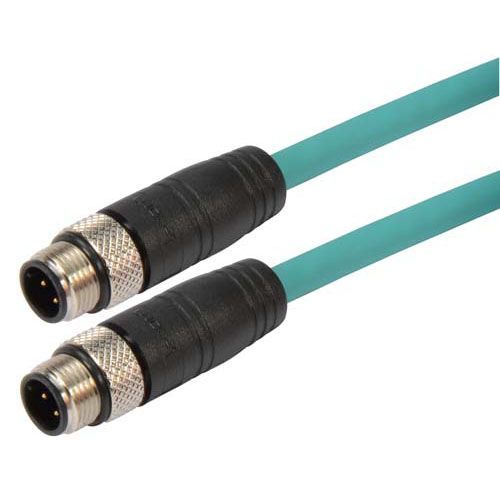
Networking takes shape in many different environments and not just in clean, dry server rooms. Many industries, including automation, robotics, and alternative energy must have access to networks but are out in the field quite often. The products used to build these networks must withstand harsh environmental factors for the long haul. Our new M12 cables manufactured by L-com provide secure connections for all of your industrial networking application needs.
What is an M12 cable?
M12 cables from ShowMeCables are category-rated ethernet cables with two connectors on either end. These circular connectors have 12mm locking threads to ensure an established connection and a tight seal. Specifically, the twelve pins within the cable meet industrial signal requirements and keep you connected to a secure network.
What makes an M12 cable special?
The difference between traditional category-rated ethernet cables and M12 ethernet cables is the environment in which they can perform. Traditional ethernet