
Cat6a
-
Posted: February 18, 2026Read more »
As data centers continue to expand in size and complexity, the importance of making informed backbone cabling decisions has never been more critical. Modern enterprise networks must be carefully engineered not only to meet the immediate bandwidth demands of today but also to accommodate rapid growth, high-density deployments, and the integration of future technologies, including 400G and beyond. The backbone cabling infrastructure serves as the foundation for scalable data centers, providing the essential connectivity that links switches, servers, storage systems, and interconnects throughout the facility. This backbone must be robust and flexible, allowing for seamless upgrades and expansions as operational needs evolve.
-
Posted: July 23, 2025Read more »
As millions of aging baby boomers enter their senior years—driving up demand for healthcare—networks must support increasingly complex and data-heavy systems (medsien.com). At the same time, rising cybersecurity threats have made fast, reliable connectivity a critical necessity (processbolt.com).
To keep up with growing demands, healthcare organizations must invest in high-speed, scalable IT infrastructure that ensures seamless performance across all operations—from patient intake to back-office systems. This post explores the key components of a reliable healthcare network and the risks of falling behind in keeping such a network in step with the times. We also provide practical solutions like upgraded cabling, PoE technology and surge protection that help future-proof healthcare environments.
Network Performance Directly Impacts Patient Experience
From telehealth consultations to electronic health record access, older patients now expect quick, responsive systems that support
-
Posted: October 22, 2019
 Read more »
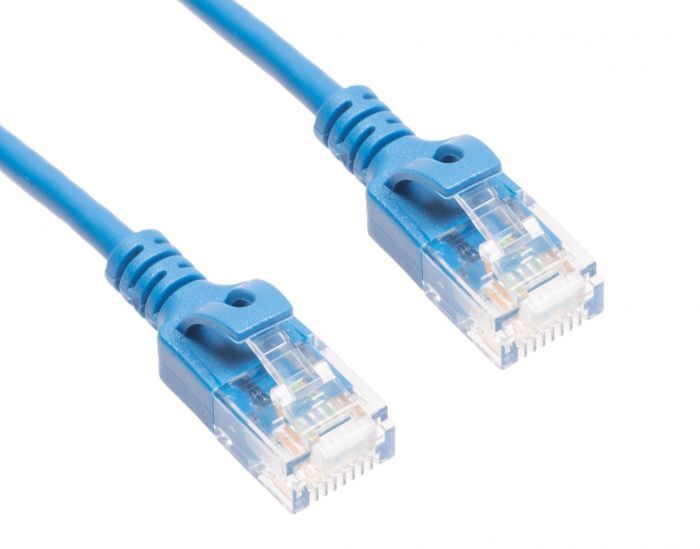
What is a Cat6a Slim Patch Cable?
A Cat6a slim patch cable is an ethernet cable, which is used with wired networks and connect devices like computers, routers and switches with a local network. Patch cables normally travel short distances (a maximum of 100 meter or 330 feet), and can be used to wire offices and server closets. This cable provides a reliable, high-speed data connection to your home or office network, and is good to keep on hand!
What Makes a Slim Cat6a Patch Cable Special?
Here are a few differences between the Cat6a slim patch cable and the Cat6 patch cable.
It is 40% thinner than its predecessor. This allows for more airflow as well as more flexibility within the cable itself. What this means for you is a tighter turn radius and less congestion, and the ability to do more in smaller spaces.
Better blocking of electromagnetic interference (EMI) and radiofrequency interference (RFI) occurs. If you are seeking a cable that needs to be next to other cables or machines that
-
Read more »
Ethernet is one of the most important types of cables today, being used to connect all manner of technology around the world to the Internet. While many stores today have pre-made ethernet cables available, sometimes another option is needed. Users may need a cable in an unusual size or just need to replace a broken connector. This guide will show users how to put an RJ45 connector onto the end of bare ethernet cable.
Before jumping into the main guide, there is an easy fix if you have a connector where the release tab broke off. When the tab breaks, the cable will not lock into place and have trouble maintaining a connection. This can be easily fixed with a Quick Snap Latch, which is a much easier repair than replacing the whole connector. If a broken latch is the only issue, grab one of those for a simple repair that will only take a few seconds.
A video guide detailing the below steps can be found at the bottom of the article.
Step 1: Gathering the Supplies
There are a few simple supplies
-
Read more »
Ethernet is one of the most common types of cables, used to connect devices like computers and routers to the Internet. The end of an ethernet cable, an RJ45 connector, looks similar to the end of a phone cable, an RJ12 modem cable, but bigger. While phone cables have four to six wires on the inside, ethernet cables use eight. Ethernet cables come in both solid and stranded variants.
Ethernet Categories
There are a few different variations of ethernet, the foremost being the cable category. This type of cable is abbreviated as “Cat#”, with higher numbers being newer versions of ethernet capable of faster signal speeds. These categories are defined by the Institute of Electrical and Electronic Engineers (IEEE).
Cat5e
Cat5e is an upgraded version of the original Cat5 cable and the current standard version of ethernet. It is capable of data speeds up to 1 Gbps (gigabyte per second) with a bandwidth of 350 MHz (MegaHertz).
Cat6
Cat6 is the next step up and will become the new standard