
Types of Fiber Optic Connectors – Simplex, Duplex, LC, ST, SC, and More


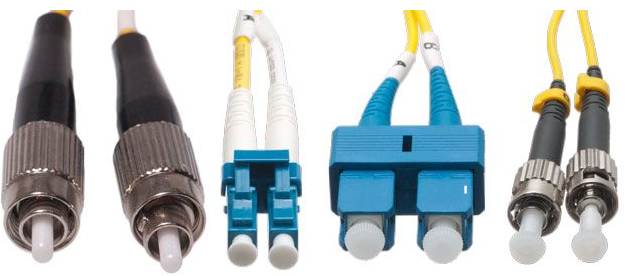
From left to right: FC, LC, SC, and ST
Fiber optic cables utilize a few different fiber connector types that can be used to terminate the cable. While they do bear some similarities, each kind has a different enough size and shape that they are not interchangeable. When preparing any fiber-related equipment for installation, it is important to make sure the cables are equipped with the right connectors for the job.
FC is an older fiber optic connector currently being phased out of industry standards. While single mode cables still use FC, it is unusual to see them on multimode cables. FC connectors take longer to unplug compared to newer fiber optic connectors due to their threaded screw-on design. Additionally, the more complex design and use of metal make them more costly to manufacture. Despite those downsides, FC still sees some use since those threads allow it to remain secure when used on moving machinery.
LC was designed as a push-pull connector that locks in place with a latch. While being faster and easier to operate is an advantage, the main draw of LC is its small size. Being about half the size of other fiber optic connectors, LC can be used on devices that would otherwise have too little room to support a fiber optic connection.
SC is arguably the most common type of fiber optic connector used today. Designed to be simple to use and inexpensive to produce, SC uses a push-pull design similar to LC but utilizes a locking tab instead of a latch to secure the unit. The cost-effective design of SC makes it a popular choice with industries that frequently use fiber cables, such as telecom and datacom.
ST uses a design similar to FC but instead of threads, it uses a locking mechanism similar to BNC coax connectors. While ST is not being phased out to the same degree as FC, it is starting to see less and less use in favor of LC and SC.
To read about the different types of fiber connections, types of fiber connectors and fiber optic cables, click here.
Key Takeaways
- Fiber optic connectors provide the physical and optical connection between fiber cables and network equipment.
- Common connector types include LC, SC, ST, FC, and MPO.
- LC connectors are useful for high-density installations.
- SC connectors use a push-pull design and are common in telecommunications and networking.
- ST connectors use a bayonet-style coupling mechanism.
- FC connectors use a threaded coupling design.
- MPO connectors support multiple optical fibers through a single interface.
- Simplex uses one fiber, while duplex uses two fibers.
- Fiber connectors can be used with both single-mode and multimode fiber.
- UPC and APC are different polishing configurations and should be selected according to system requirements.
- Always match the connector with the equipment port, fiber type, polish, and application.
- For harsh environments, consider ruggedised, armoured, or waterproof fiber assemblies where appropriate.
- Proper cleaning, inspection, and connector protection are important for maintaining reliable fiber-optic performance.
Simplex vs. Duplex
All types of fiber cables come in either simplex or duplex configuration. A connector by itself is simplex while a pair of connectors together is duplex. Duplex is the more common of the two since fiber cables are typically used in pairs. When a signal is sent through a fiber cable, it is one-way. A simplex fiber cable cannot send and receive signals at the same time. A duplex connector, with two attached fiber cables, must be used for any set-up that will both send and receive signals.
Simplex connectors are usually used for repairs and replacements. Some duplex connectors are not molded together; they are sometimes made completely separate plastic pieces or two pieces that click together into one unit. In the event only one side of a duplex connector breaks, a simplex connector can be used to replace the broken side instead of the whole unit.
APC vs. UPC

A green color-coded APC connector (left) vs. a UPC connector (right)
Along with standard ends, fiber connectors can be made with UPC (Ultra Physical Contact) or APC (Angled Physical Contact) specifications. A cable with one of these specs will have the suffix “-UPC” or “-APC” added onto its name. For example, a fiber cable with SC connectors would be labeled SC-UPC or SC-APC, respectively.
UPC connectors are made using a special polishing technique, altering the glass inside the connector to allow laser signals to pass through more easily. While this does increase signal speed, it also makes the glass easier to damage. If a UPC fiber cable is plugged/unplugged frequently, it will experience wear-and-tear faster than a standard or APC equivalent.
APC connectors eliminate UPC’s wear-and-tear issue by angling the glass in the connectors at an 8° angle in addition to the special polishing technique. The angle stops extra damage from occurring while also allowing for tighter, more secure connections. The only downside is that the angle requires the connector to be plugged in right-side up; unlike standard and UPC connectors, it is possible to have an APC connector upside down.
MPO/MTP
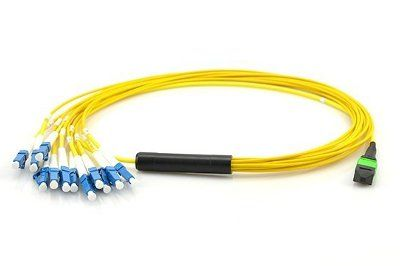
MPO/MTP are names used for a special type of multi-fiber connector. Larger in size than more commonplace connectors, MPO/MTP is capable of supporting up to 24 strand fiber. This makes standard MPO/MTP cables ideal in environments where manyfiber connection types are needed, such as data centers.
MPO/MTP is also used for breakout cables. These cables use MPO/MTP on one end and a number of LC or SC connectors on the other. With 24 strands to work with, the opposite side can hold either 12 simplex or 6 duplex connections. Breakout cables are an ideal way to shorten installation time by minimizing the number of cables that need to be run and connected.
Tips for Choosing Fiber Optic Connectors
Choosing the right fiber optic connector requires more than matching the connector shape. The connector must be compatible with the fiber, equipment, network architecture, and installation environment. Use these tips when selecting fiber optic connectors and cable assemblies.
1. Identify the Equipment Interface
Before purchasing a fiber optic cable, identify the connector port on the switch, transceiver, patch panel, or other equipment. Common interfaces include LC, SC, ST, FC, and MPO.
2. Check Single-Mode or Multimode Fiber
Determine whether the network uses single-mode or multimode fiber. Using a connector assembly designed for the wrong fiber type can result in compatibility and performance issues.
3. Verify the Fiber Category
For multimode applications, check whether the system uses OM1, OM2, OM3, OM4, or OM5 fiber. For single-mode systems, verify whether OS1 or OS2 is required.
4. Choose Simplex or Duplex.
Select simplex when the application requires one fiber and duplex when two fibers are required. Duplex connections are commonly used when separate fibers are needed for transmitting and receiving data.
5. Check UPC or APC Polishing
Determine whether the equipment requires UPC or APC connectors. Do not assume that the two polishing types are interchangeable. Match the connector polish to the equipment and existing fiber infrastructure.
6. Consider Connector Density
For installations with limited rack or patch-panel space, compact LC connectors can be a practical choice. For high-density multi-fiber applications, consider MPO/MTP connectors when supported by the network equipment.
7. Match the Connector to the Existing Infrastructure
If you're replacing an existing fiber patch cable, match the connector type, fiber mode, configuration, and polish rather than selecting a connector based only on appearance.
8. Consider the Installation Environment
For standard indoor networking environments, conventional fiber patch cables may be sufficient. Industrial, outdoor, or demanding installations may require ruggedised, armoured, waterproof, or otherwise specialised fiber assemblies.
Fiber Connectors From ShowMeCables
ShowMeCables offers both single mode and multimode fiber optic patch cables with all types of connectors available. We also carry bulk cable and connectors for on-site termination projects. Patch cables range from 1 to 50 meters (3.28 to 164 feet) in length with custom options available as well. Stock items include armored cables, plenum jackets, loopback testers, and more.
Each and every cable and connector is built to federally regulated standards and backed up by warranty. Have questions about fiber optics or any of our other products? You can reach our Sales team at 1-888-519-9505 or Sales@ShowMeCables.com
FAQs – Frequently asked questions
What is an MPO connector?
An MPO connector is a multi-fiber connector designed to connect multiple optical fibers through a single interface. It is commonly used in high-density data centres and network applications.
What is the difference between simplex and duplex fiber?
Simplex fiber uses one optical fiber, while duplex fiber uses two fibers. Duplex configurations are commonly used when separate transmit and receive paths are required.
What is the difference between single-mode and multimode fiber?
Single-mode fiber has a smaller optical core and is generally used for longer-distance transmission. Multimode fiber has a larger core and is commonly used for shorter-distance network links.