
RJ45 Pinout


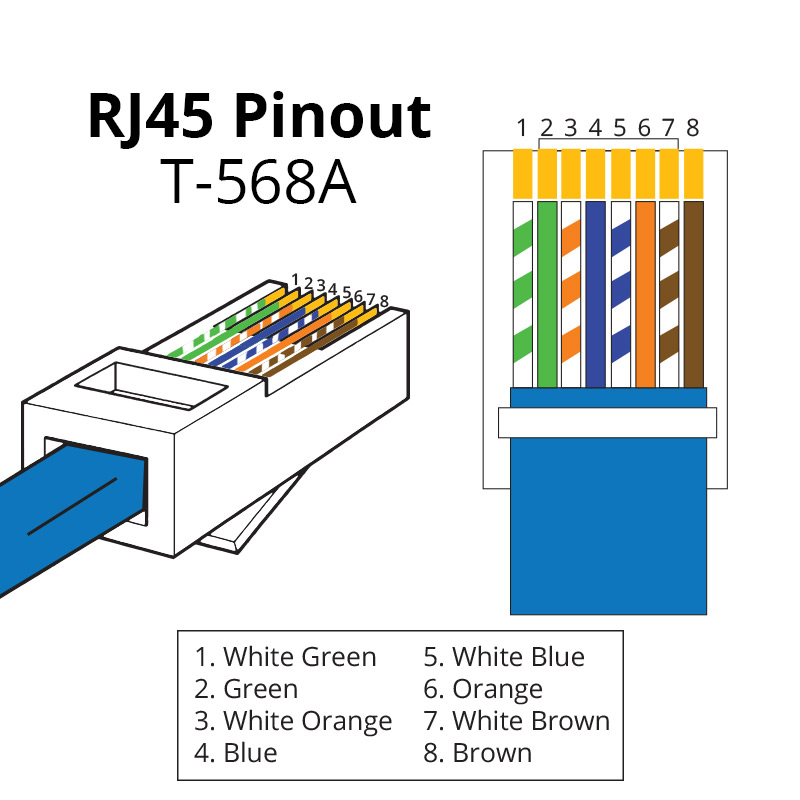
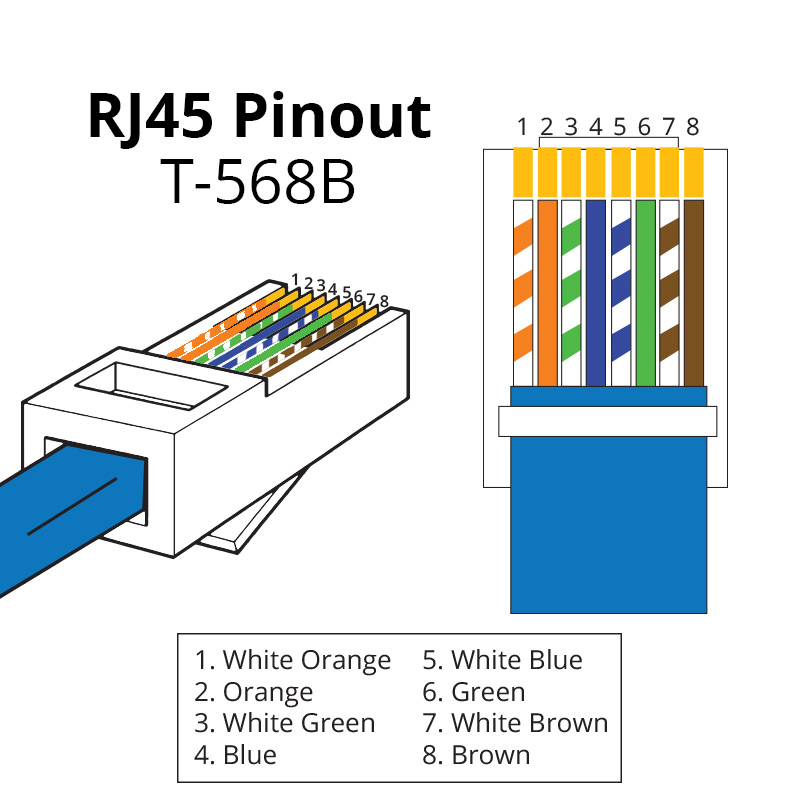
A RJ45 connector is a modular 8 position, 8 pin connector used for terminating Cat5e or Cat6 twisted pair cable. A pinout is a specific arrangement of wires that dictate how the connector is terminated. There are multiple pinouts for RJ45 connectors including straight through (T568A or T568B), crossover, rolled, T1, and loopback. Straight through is the most common type of cable and is used for connecting your computer to your network. The other pinouts are for specialty cables that are used for unique network applications. Straight-Through Pinout Within the family of straight-through color codes, there are two standards recognized by ANSI, TIA and EIA. The first is the T568A wiring standard and the second is T568B. T568B has surpassed 568A and is seen as the default wiring scheme for twisted pair structured cabling. If you are unsure of which to use, choose 568B.
Key Takeaways
- RJ45 pinout refers to the arrangement of the eight conductors inside an Ethernet connector.
- The two commonly used Ethernet wiring standards are T568A and T568B.
- T568B is widely used for Ethernet patch cables, while T568A is also an accepted standard.
- The eight conductors are arranged as four twisted pairs: orange, green, blue, and brown.
- A straight-through Ethernet cable uses the same wiring standard on both ends.
- Mixing T568A and T568B on opposite ends creates a crossover cable, which has different transmit and receive pair assignments.
- Correct termination is important for maintaining Ethernet connectivity and network performance.
- RJ45 wiring should be checked carefully when making custom cables or troubleshooting network connectivity.
- ShowMeCables documentation uses the standard eight-pin RJ45/8P8C connector and identifies the individual wire positions in its cable wiring maps.
T-568A RJ45 Pinout
 T-568B RJ45 Pinout
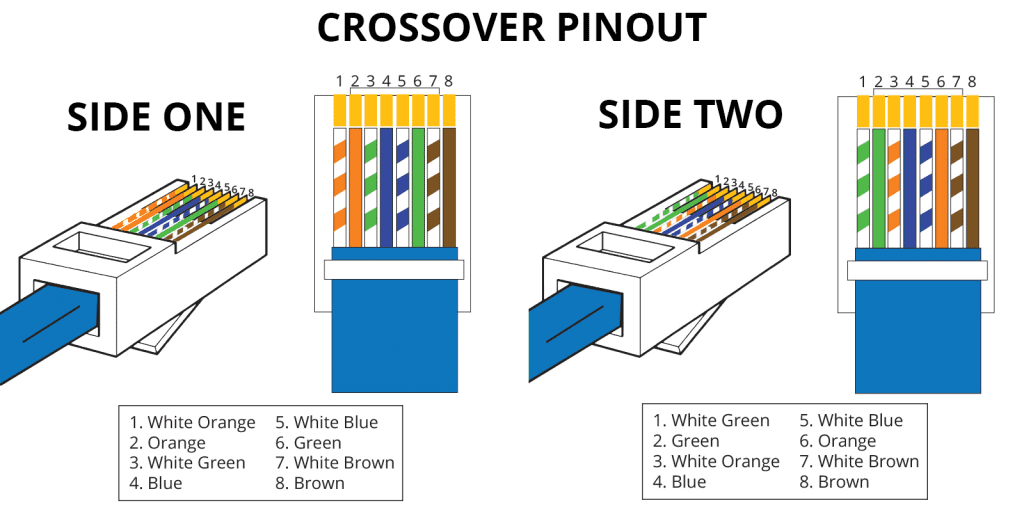
Cross Over Pinout
A crossover cable utilizes two different RJ45 pinouts for the two ends of the cable. If you need to connect 568A equipment to 568B you can use a crossover cable.
Recommendations
1: Use T568B for Conventional Patch-Cable Applications
For many standard Ethernet installations, T568B is a practical choice because of its widespread use. However, the most important consideration is consistency. If an existing installation uses T568A, continue using that standard rather than changing the wiring unnecessarily.
2: Follow the Existing Site Standard
When adding cables to an existing network, identify the wiring standard already being used. Matching the existing infrastructure helps maintain consistency and simplifies future maintenance.
3: Use Factory-Terminated Cables When Appropriate
For critical network installations, professionally manufactured and tested patch cables can reduce termination errors. ShowMeCables provides RJ45 cable assemblies across different categories and configurations, with technical documentation that specifies wiring maps and connector details.
4: Test Custom-Made Cables
If cables are terminated manually, test them before installation. A basic cable tester can identify wiring mistakes before they become troubleshooting problems.
5: Consider the Network Speed
Select the appropriate Ethernet cable category for the intended application. Higher-speed networks can have stricter requirements for cabling performance, connector quality, installation practices, and overall channel design.
FAQs – Frequently Asked Questions
What is an RJ45 pinout?
An RJ45 pinout describes the arrangement and assignment of the eight wires or contacts in an RJ45/8P8C Ethernet connector.
What are T568A and T568B?
T568A and T568B are two recognised wiring arrangements for terminating twisted-pair Ethernet cables. They use the same four wire pairs but arrange the orange and green pairs differently.
Which RJ45 wiring standard should I use?
For a new installation, follow the applicable cabling standard and the convention used by the installation. For extending an existing network, matching the existing wiring scheme is usually the simplest approach.
What is a straight-through Ethernet cable?
A straight-through cable uses the same wiring standard at both ends, such as T568B on both ends.
What is a crossover Ethernet cable?
A crossover cable uses different wiring standards on its two ends, traditionally T568A on one end and T568B on the other. This changes the pair assignments between the connectors.