
Ethernet vs. Phone Cables – What’s the Difference?


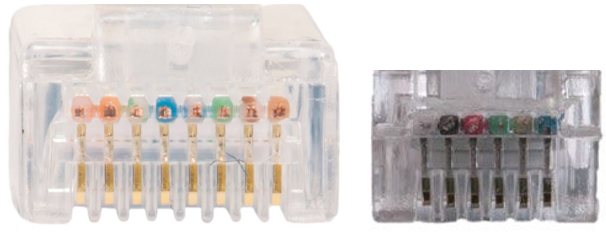
The end of an RJ45 Ethernet connector (left) vs. an RJ12 phone connector (right)
Ethernet and telephone cables look fairly similar and it is not uncommon to get the two mixed up. The key difference between the two is the size of the plastic connectors on the ends of the cable. Telephones use an RJ11/RJ12 connector whereas Ethernet uses RJ45. RJ11/RJ12 only uses 4-6 pins whereas RJ45 uses 8 pins. As a result, RJ11/RJ12 is physically smaller than RJ45 since it does not need to contain as many pins. See the RJ11 to RJ45 wiring diagram for more info.
Key Takeaways
- Ethernet and telephone cables serve different primary purposes.
- Ethernet cables are designed for networking and data transmission.
- Telephone cables are commonly used for voice and telephone-line connections.
- RJ45/8P8C connectors are commonly associated with Ethernet, while RJ11 connectors are commonly associated with telephone equipment.
- Ethernet cable categories include Cat5e, Cat6, Cat6a, Cat7, and Cat8.
- Similar-looking connectors do not mean that Ethernet and telephone cables are interchangeable.
- Traditional telephone cable should not automatically be used for Ethernet.
- Cat5e or Cat6 cabling can be used for some voice applications when appropriately terminated.
- Ethernet selection should consider speed, cable category, length, shielding, and installation environment.
- Existing telephone wiring should be evaluated before attempting to use it for Ethernet.
- Testing and labelling cables can make installation and troubleshooting easier.
- Choose the cable according to the application and required performance—not simply because the connector appears to fit.
Modular Connectors
Both Ethernet and telephone cables are made using modular connectors. These are connectors that were designed to be used with registered jack (RJ) twisted-pair cables. The original modular jacks were invented by AT&T in the 1960s and used for some telephones. Over time they caught on and eventually became industry-standard in the 1970s.
Each type of modular connector has an RJ designation, but can also be referred to as “#P#C”. The first number is the number of metal pins (P) inside the connector. The second number is how many of those pins are actually connected to wires. Connected pins are called contacts (C). Modern telephones use either RJ11 (6P4C) or RJ12 (6P6C). Having more wires inside the telephone cable allows more signal pairs to run through a single cable, such as having a telephone and fax machine both hooked up through one line. The extra number of wires in the newer RJ12 also makes it backward compatible with RJ11 (on the flipside, RJ11 is not forward compatible with RJ12).
Because data signals are more complex than telephone signals, these older jacks did not cut it for Internet usage once the World Wide Web was invented. RJ45 (8P8C) was developed to use four pairs of wires for just that purpose. Since an extra pair of wires is needed, RJ45 connectors are physically bigger than RJ11/RJ12. While there are a few different kinds of Ethernet available, they all use RJ45 connectors in their construction. Checking the size and counting the number of pins in a connector are the easiest ways to see whether a cable is an Ethernet or telephone cord.
Other Telephone Connectors (RJ22)
While RJ11/RJ12 is the most common kind of phone cable, it is not the only type available. RJ11/RJ12 cables are used to connect phones and fax machines to wall outlets. However, they will not work when connecting a handheld receiver to the base of the telephone. Coiled handset cords are made using RJ22 (4P4C) connectors, which are even smaller than RJ11/RJ12. Since these cords do have a tendency to wear out and become damaged over time, using a cord detangler is recommended in order to prevent the cord from wrapping around itself and speeding up wear-and-tear.
Tips for Choosing Ethernet vs. Phone Cables
1. Identify the Application
First, determine whether the cable is required for networking or telephone communication. Ethernet cables are designed for data networking, while traditional telephone cables are generally intended for voice and telephone-line applications.
2. Check the Connector
Inspect the connector on the equipment. Ethernet commonly uses an RJ45/8P8C-style connector, while telephone equipment commonly uses an RJ11-style connector. ShowMeCables lists RJ11 and RJ45 separately within its networking and voice connector categories.
3. Check the Number of Pairs
Ethernet cables typically contain multiple twisted pairs designed for data transmission. Traditional telephone cables may use fewer pairs depending on the application. Do not assume that a telephone cable has the same wiring or performance characteristics as an Ethernet cable.
4. Don't Judge Compatibility by Connector Appearance
RJ11 and RJ45 connectors look similar, but they are not automatically interchangeable. A connector that physically fits does not necessarily mean that the cable, wiring, and equipment are electrically compatible.
5. Check Existing Wiring
If you're considering using existing telephone wiring for networking, inspect the cable type, number of pairs, termination, and condition first. Do not assume that old telephone wiring can support the Ethernet performance you need.
FAQs – Frequently asked questions
What is the difference between Ethernet and phone cables?
Ethernet cables are designed primarily for network data transmission, while traditional telephone cables are generally designed for telephone and voice applications.
Are Ethernet and phone cables the same?
No. They can have similar-looking modular connectors, but their wiring, construction, performance, and intended applications can differ.
Is RJ11 smaller than RJ45?
Yes. RJ11-style telephone connectors are generally narrower than the 8P8C connectors commonly used for Ethernet.
Ethernet & Phone Cords from ShowMeCables
Whether you need Ethernet cables, telephone cords, or any kind of cable accessory to go with them, ShowMeCables is ready to help. With thousands of cables kept in stock at our St. Louis, MO warehouse and same-day shipping on orders placed before 5:00 pm CST, ShowMeCables can get your order shipped out today.
Have questions about Ethernet, phone cables, or any of our other products? You can reach our Sales team at 1-888-519-9505 or Sales@ShowMeCables.com