
Coaxial (Coax) Connectors - RF Types


Along with the many types of coax cables there are to pick from, there is also an assortment of different types of RF coax connectors. When selecting a connector, you need to make sure you select one rated for the cable you are assembling. The back end of the RF connector that attaches to the coax cable needs to be the right size for installation. If the connector is too small, it will not fit. If it is too big, the connector will not secure properly and can be pulled off or even just fall off.
Key Takeaways
- Coaxial connectors are used to connect coaxial cables to electronic equipment, antennas, RF systems, video equipment, and other devices.
- Coax connectors are available in many configurations, including BNC, SMA, N-type, F-type, TNC, and others.
- Connector selection depends on factors such as frequency, impedance, application, cable type, environmental conditions, and mechanical requirements.
- 50-ohm and 75-ohm coaxial systems are common, so the connector and cable should be selected to match the system.
- BNC connectors are widely used in video, test equipment, and RF applications.
- SMA connectors are commonly used in RF and microwave applications where compact size and high-frequency performance are important.
- N-type connectors are frequently used in RF, wireless, antenna, and outdoor applications.
- F-type connectors are commonly associated with television, cable, satellite, and broadband applications.
- Connector gender, interface type, mounting configuration, and termination method should be checked before purchasing.
- Proper installation is important for maintaining signal integrity and preventing intermittent connections.
- For RF applications, connector specifications such as frequency range, VSWR, insertion loss, and impedance may be important selection criteria. ShowMeCables documentation, for example, specifies 50-ohm SMA assemblies and their frequency and VSWR characteristics.
The type of RF connector you need will be determined by the equipment used with the coax cable. A television coax connection, for example, uses an F-type connector as the industry standard. Not every connector can be used with every type of coax cable, but all types of coax cables do support multiple types of RF connectors.
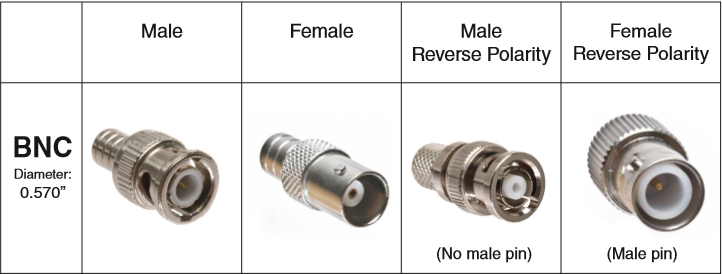
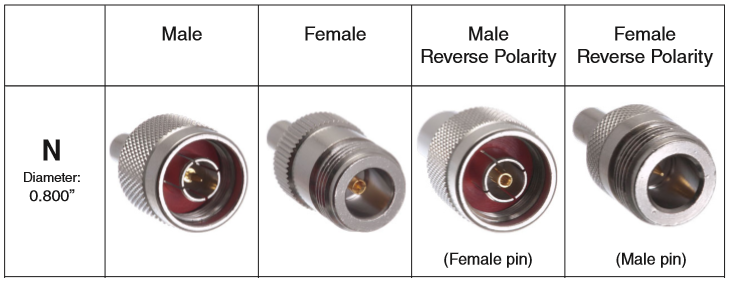
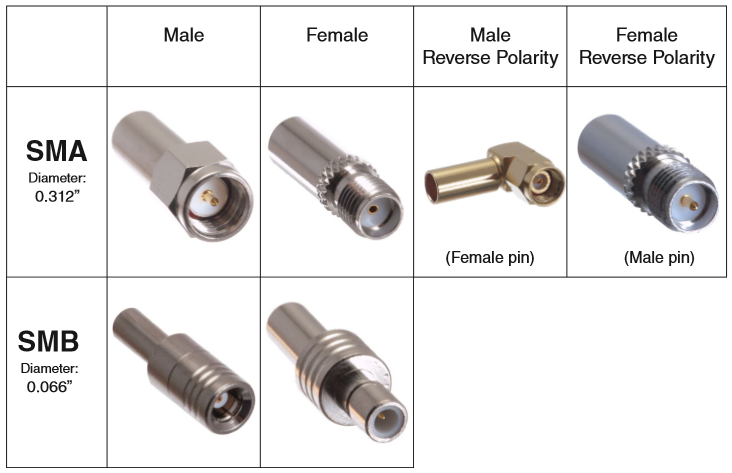
Every connector comes in two versions, male and female. A male connector will have a pin in the center while a female connector has a hole. If you are using an RP (Reverse Polarity) connector, this is switched. Male RP will have the hole while female RP has the pin. The term “reverse polarity” refers to the fact that the hole and pin are switched. They do not change the polarity of the signal going through the cable.
RP connectors were originally implemented by the FCC to try to stop members of the public from using antennas and other equipment to boost their Wi-Fi signals, in violation of federal law. This worked for a few years but now RP connectors are just as available on the open market as their conventional counterparts.
Common types of coax RF connectors include:
- BNC
- F-type
- N-series
- TNC
- UHF (PL-259/SO-239)
- SMA/SMB
- FME
- QMA
- PAL
- MC/MCX/MMCX
- DIN/Mini-DIN
- TS-9
- NMO
BNC
BNC (Bayonet Neill-Concelman) connectors are available for most types of coax cable. They come in both 50 ohm and 75 ohm versions. Originally developed in the 1980s for military use, today BNC connectors are commonly used on radios and security cameras. They are used at low frequencies, typically below 4 GHz.
TNC
TNC (Threaded Neil-Concelman) is an upgraded version of BNC that uses threads to secure itself. These threads minimize leakage and allow the connectors to work at frequencies up to 12 GHz. TNC connectors also have the benefit of being weatherproof and is commonly used for outdoor applications like antennas and cell towers. A reverse polarity version is also available.

F-type
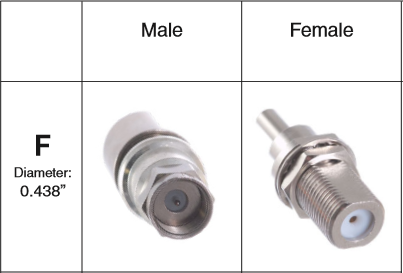
F-type connectors are the type of RF connector seen on the backs of televisions. These connectors are most commonly used on RG59, RG6, and RG11 cable, although there are other options. They can be used for antenna, cable, and satellite television as well as cable modems.
N-series
N-series connectors, named after inventor Paul Neill, are a 50 ohm connector originally developed for military use. 75 oh versions do exist today, but they are much less common and incompatible with the 50 ohm version. Modern N-series connectors can handle frequencies up to 18 GHz and are also available in reverse polarity.
UHF (PL-259/SO-239)
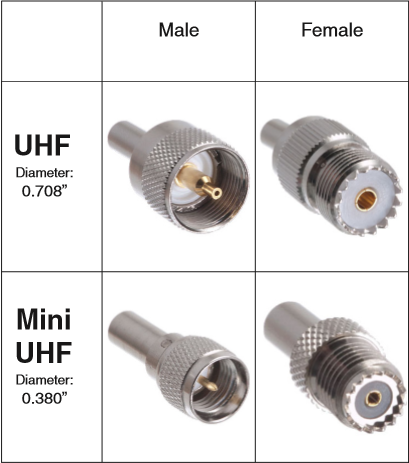
UHF connectors are also referred to as PL-259 (male) and SO-239 (female). Originally built for military use during World War II, today UHF connectors are primarily used for amateur radios. At 50 ohms, it is most commonly seen on RG58 and RG8 as well as their LMR equivalents. There is also a Mini-UHF connector version designed for equipment where space is limited, like a cell phone.
SMA/SMB
SMA (Subminiature A) is a miniature sized threaded connector that is much smaller than most other coax options. At 50 ohms, it is usually used on RG58 or thinner coax at frequencies up to 24 GHz and is environmentally sealed. They are also available in reverse polarity. SMB (Subminiature B) is used with high-frequency equipment built for a maximum transmission of 4 GHz, with a snap-on connection.
QMA
QMA is an upgrade to SMA, being built to connect/disconnect easily and quickly. This is a newer type of coax connector, introduced in 2003, and has not widely caught on yet. Until QMA becomes more widespread, the number of coax cables it is available for will be limited.
FME
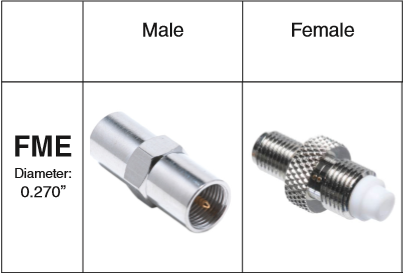
FME is another 50 ohm miniature RF connector that is mainly used with RG58. The small size of FME allows it to be run through holes and conduit that other coax connectors are too large for.
PAL
PAL (Phase Alternating Line) is a type of connection used in Australia, most of Europe, and parts of Asia, Africa, and South America. In the United States, the only time you will see PAL is if you need an adapter for connecting to a piece of equipment manufactured to international standards.
MC/MCX/MMCX
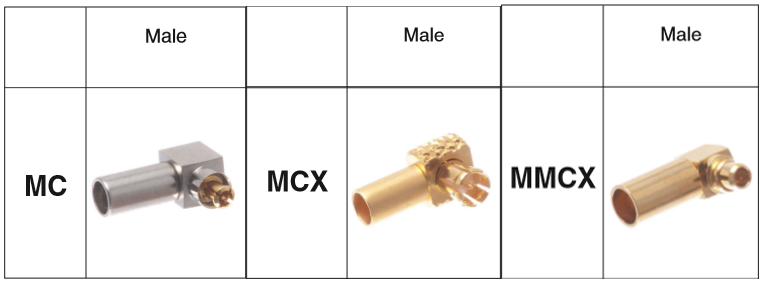
MC (Microcoaxial), MCX (Micro Coaxial Connector), and MMCX (Micro-Miniature Coaxial) are all types of downsized coax connectors used in areas where other coax connectors would take up too much space. MC is used for cars, antennas, and GPS. MCX was developed for the Apple Airport Extreme Base Station’s antenna and is also used on GPS. MMCX also sees use on GPS in additional to being used on tuners for computers to connect to Wi-Fi.
DIN/Mini-DIN
DIN/Mini-DIN cables for single line coax come in a few varieties. 1.0/2.3 was developed in the 90s for telecom systems. The 50 ohm version works with frequencies up to 10 GHz while the 75 ohm version supports a maximum of 4 GHz. 4.1/9.5 and 4.3/10 have similar functionality but are larger sizes, for use with thicker types of coax cable. 7/16 is a full-sized 50 ohm DIN that looks similar to an N-series connector. These types of RF connectors are German designed and known for their ability to support high levels of power.
TS-9
TS-9 is a very small connector used in compact devices like cell phones. Its small size means it must be used with very thin cable, such as LMR-100 and LMR-195.
NMO
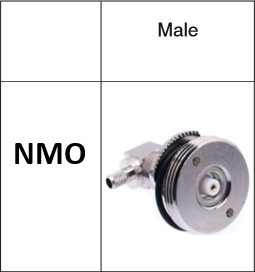
NMO connectors are removable connectors that double as antenna mounts, designed to be used with Motorola products. They are used with RG58 and LMR-195 cable.
Recommendations
- Do not select a coaxial connector independently from the rest of the system. Consider the cable, equipment, frequency range, impedance, environment, and mechanical requirements together.
- RF systems can be sensitive to connector performance. For demanding applications, review specifications such as impedance, frequency range, VSWR, insertion loss, and return loss where applicable.
- Video systems may have specific impedance and connector requirements. For example, professional SDI systems commonly use 75-ohm BNC connections. ShowMeCables documentation includes 75-ohm BNC cable assemblies designed for 12G-SDI applications.
- For applications where installation time and consistent termination quality are important, factory-terminated coaxial cable assemblies can be a practical option.
- Before purchasing a connector, confirm the connector type, gender, impedance, cable compatibility, frequency range, mounting style, and environmental requirements.
FAQs – Frequently asked questions
What is a coaxial connector?
A coaxial connector is a mechanical and electrical interface used to connect coaxial cable to another cable, device, antenna, or piece of electronic equipment.
What are the most common coaxial connectors?
Common types include BNC, SMA, N-type, F-type, and TNC connectors. The appropriate connector depends on the application.
What is a BNC connector used for?
BNC connectors are commonly used in video equipment, test instruments, RF systems, and other applications requiring a secure bayonet-style connection.