
DB9 Connector Pinout


When building or repairing DB9 cable assemblies many customers request a DB9 connector pinout reference drawing in order to determine where each conductor of the cable should be terminated to. There are several primary types of DB9 connector pinout schemes that we will review in blog post.
Key Takeaways
- A DB9 connector is a nine-contact D-sub connector commonly used for serial and control applications.
- DB9 and RS-232 are not the same thing; DB9 identifies the physical connector, while RS-232 identifies a communication interface.
- Always verify the DB9 connector pinout before wiring or replacing a cable.
- Male and female DB9 connectors have different physical contact configurations.
- Straight-through and null modem cables use different wiring configurations.
- TXD, RXD, and GND are important signals in common RS-232 DB9 applications.
- Not every DB9 connector follows a standard RS-232 pinout.
- OEM equipment may use custom DB9 pin configurations for communication and control.
- Correct connector orientation is essential when reading a DB9 pinout diagram.
- Before purchasing a DB9 cable, verify the connector gender, pinout, communication standard, cable type, and equipment requirements.
DB9 Connector Pin Locations
First, we will take a look at the DB9 connector pin locations for a male and female DB9 connector. Note the orientation of the connector where the short side of the shell is located on the bottom and the longer side is on the top.
There are several DB9 connector Pinout schemes to address different standards and technologies. Here we take a look at two of the predominantly used configurations.
DB9 connectors used for RS232 communications
DB9 connectors have long been used in serial communications to attach peripherals to PCs. With the advent of USB connectors, DB9 is no longer the connector of choice for this function but there are still legacy devices using DB9 connectors for RS232 connectivity.

Another use for DB9 connectors is with Null modem communications.
A null modem DB9 serial cable (frequently called a crossover cable) is used to connect two Data Terminal Equipment (DTE) devices together without the use of a Data Circuit Equipment (DCE) device in between. For this to work, the transmit (TXD) and receive (RXD) pins on one of the serial connectors are flipped.
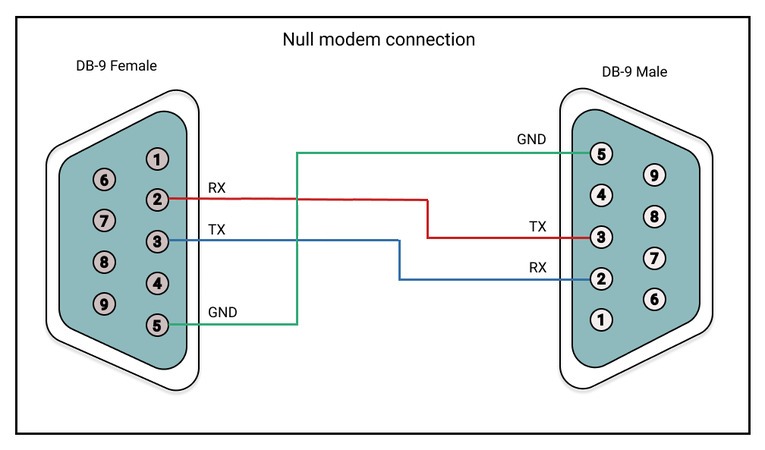
In addition to the DB9 connector pinouts we just reviewed, there are many custom DB9 pinout configurations used by OEM’s to performance a variety of communications and control functions.
We hope you found this DB9 Connector Pinout blog post helpful.
Tips for Choosing a DB9 Cable
1. Identify the Connector Gender: Determine whether the equipment requires a male or female DB9 connector.
2. Confirm the Pinout: Verify the required pin configuration before purchasing or wiring a cable.
3. Determine the Communication Standard: If the cable is being used for RS-232 communication, confirm that the equipment uses the appropriate RS-232 interface.
4. Check Straight-Through vs. Null Modem: Determine whether the application requires a standard straight-through connection or a crossover/null modem configuration.
5. Verify the Equipment Documentation: Always check the manufacturer's wiring information when working with specialized or OEM equipment.
6. Consider Cable Length: Choose a cable length that provides enough reach without creating unnecessary slack.
7. Consider Shielding and Construction: For industrial or electrically noisy environments, consider the cable construction and shielding requirements of the application.
8. Verify the Connector Configuration: Make sure the connector's physical configuration matches the equipment and installation requirements
FAQs – Frequently asked questions
What is a DB9 connector?
A DB9 connector is a nine-contact D-subminiature connector commonly used for serial communication and other control or interface applications.
What is a DB9 pinout?
A DB9 pinout identifies the location and function of each of the nine connector contacts. It is used to determine how a DB9 cable or connector should be wired.
What is the standard DB9 RS-232 pinout?
A commonly used RS-232 DB9 interface assigns pins to signals such as DCD, RXD, TXD, DTR, GND, DSR, RTS, CTS, and RI. However, the exact implementation should be verified against the equipment documentation.
Are DB9 and RS-232 the same thing?
No. DB9 describes the physical connector, while RS-232 describes an electrical and communication interface. A DB9 connector can be used for RS-232, but not every DB9 connector necessarily uses RS-232.