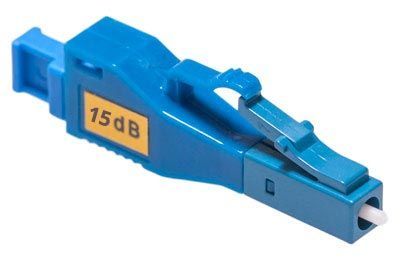
Q: What is an attenuator?
A: An attenuator makes the signal weaker in a network when it is too strong.
Q: When would I use an attenuator?
A: You would use an attenuator when the power level is too strong in your network. If you exceed the maximum input power level you can damage your equipment. You might use one of these when you need a lower signal level for a fiber line.
Q: Can I get 18 dB of attenuation by cascading a 15 dB and a 3 dB attenuator?
A: Yes you can. Attenuators are additive so 15 dB + 3 dB = 18 dB.
Q: Can I use any fiber patch cable in my network or do I have to order a specific type?
A: Whenever you need to add more fiber to an existing network you must match the mode (singlemode or multimode) micron size (62.5/125 or 50/125) and connector type.
Q: What are the differences between the fiber connectors?
ST- Uses a push and turn to lock system
SC- Has a molded plug casing with push and pull locking system
LC- Small form factor that resembles an SC connector
MTRJ- Small form factor with a square plastic casing


Q: What is the the difference between UPC fiber connectors and APC fiber connectors?
A: UPC stands for Ultra Physical Contact and APC stands for Angled Physical Contact. UPC connectors are finely polished on the ends of the fibers in order to decrease insertion loss and increase return loss (the higher the return loss the better the connection). UPC connectors have a return loss of more than 50dBs. The APC connectors were made to decrease insertion loss and increase the return loss even more. APC connectors have a return loss of more than 60dB. The end face of the APC connector fiber is polished at an 8 degree angle which prevents back reflections that degrade the performance of your system.