The store will not work correctly in the case when cookies are disabled.
JavaScript seems to be disabled in your browser.
For the best experience on our site, be sure to turn on Javascript in your browser.
Home
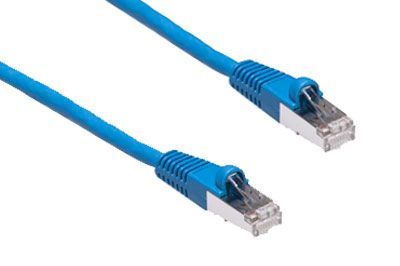
Cat7 (SSTP) Shielded Patch Cable- Blue - 2 FT
Cat7 (SSTP) Shielded Patch Cable- Blue - 2 FT
26 AWG Pure Copper Conductor | + 600 MHz | SSTP | PoE
Quantity Discount Pricing
1-9
10-24
25-99
100-249
250+
$12.19
$11.70
$10.96
$10.34
$9.73
Quantity Available: 81
Cat7 Ethernet Cables - 2FT Blue Shielded Cat7 Patch Cable
The future of network technology is here. Sending 10 gigabit Ethernet over four double shielded twisted pairs (SSTP) at a distance of 100 meters, Cat7 is one of the most advanced technologies being employed. Current Cat7 standards allow 10 gigabit Ethernet up to 100 meters, so if you need a long, fast, and reliable signal then Cat7 is for your network.
Features:
Connector 1: RJ45 Male
Connector 2: RJ45 Male
SSTP (double shield) Twist Pair
600MHz rated
CM Type PVC Jacket
55% coverage for braided shield
26AWG 4pair Stranded Copper Wire
50 Micron Gold Plated shielded RJ45 Plug
RoHS compliant
Power over Ethernet (PoE) Compatible
Supports IP Cameras
Q: What is and N connector?
A: An N connector is a threaded RF connector.
Q: What is an N connector commonly used for?
A: An N connector is commonly used on wireless and cellular base stations.
Q: Is an N connector weatherproof?
A: Yes Male N connectors have a rubber o-ring inside of them making them weatherproof.
Q: How can I tell the difference between a 50 and 75 Ohm N connector?
A: You can tell the difference by the center pin. A 50 Ohm connector has a pointed pin. A 75 Ohm has a rounded pin.
Q: What is a TNC connector?
A: A TNC connector is a threaded RF connector. Very similar to a BNC but threaded.
Q: What is an TNC connector commonly used for?
A: TNC connectors are commonly used in radio communications and wifi networks.
Q: How can I tell the difference between standard and reverse polarity connectors?
A standard male will be internally threaded with a male pin. A standard female will be externally threaded and accept a pin. A reverse polarity male will be internally threaded and accept a pin. A reverse polarity female will be externally threaded with a male pin.