
How Can You Tell the Difference Between XLR and DMX?


XLR and DMX cables have a bit of overlap and it can be difficult to keep the two separate. The short answer is that XLR cables are used for audio while DMX cables are for lighting. Both cables use the same kind of connectors and look the same on the outside, there are differences on the inside. There is a little bit of cross-functionality, but XLR and DMX should not be interchanged unless users find themselves in a desperate situation.
Key Takeaways
- XLR and DMX are not the same thing.
- XLR primarily refers to a family of connectors, while DMX is a digital lighting-control protocol.
- DMX systems commonly use XLR-style connectors.
- DMX equipment may use 3-pin or 5-pin connectors.
- A standard microphone XLR cable should not automatically be considered a DMX cable.
- For reliable lighting-control systems, use cable designed for the electrical requirements of DMX.
- Check connector type, pin configuration, impedance, shielding, cable length, and construction before purchasing.
- Keep audio and lighting-control cables clearly identified in mixed installations.
- Proper DMX termination and cabling practices can help maintain signal integrity.
- For touring and live-event applications, choose cables that can withstand repeated handling.
- The connector alone does not determine whether a cable is suitable for DMX; the cable's electrical characteristics and intended application matter as well.
Are DMX and XLR Connectors the Same?
Whereas DMX refers to something specific, “XLR” is more of a catch-all term. It can refer to an XLR cable, XLR connector, or even audio cables in general. Oftentimes, microphone cables are referred to as XLR even if they may feature another kind of audio connection as well. DMX cables do use XLR connectors, but their specialized use has given them their own name as well. Users unfamiliar with all the different XLR options may need to clarify exactly what “XLR” means when they hear the term used.
XLR cables are used with professional audio equipment, such as microphones, mixers, amplifiers, and soundboards. While there are a few different varieties of XLR connectors out there, the most common is the 3-pin version. Each pin is used for positive, negative, and a ground, respectively. If more pins are needed for additional signals, XLR connectors with more than 3 pins may be used instead.
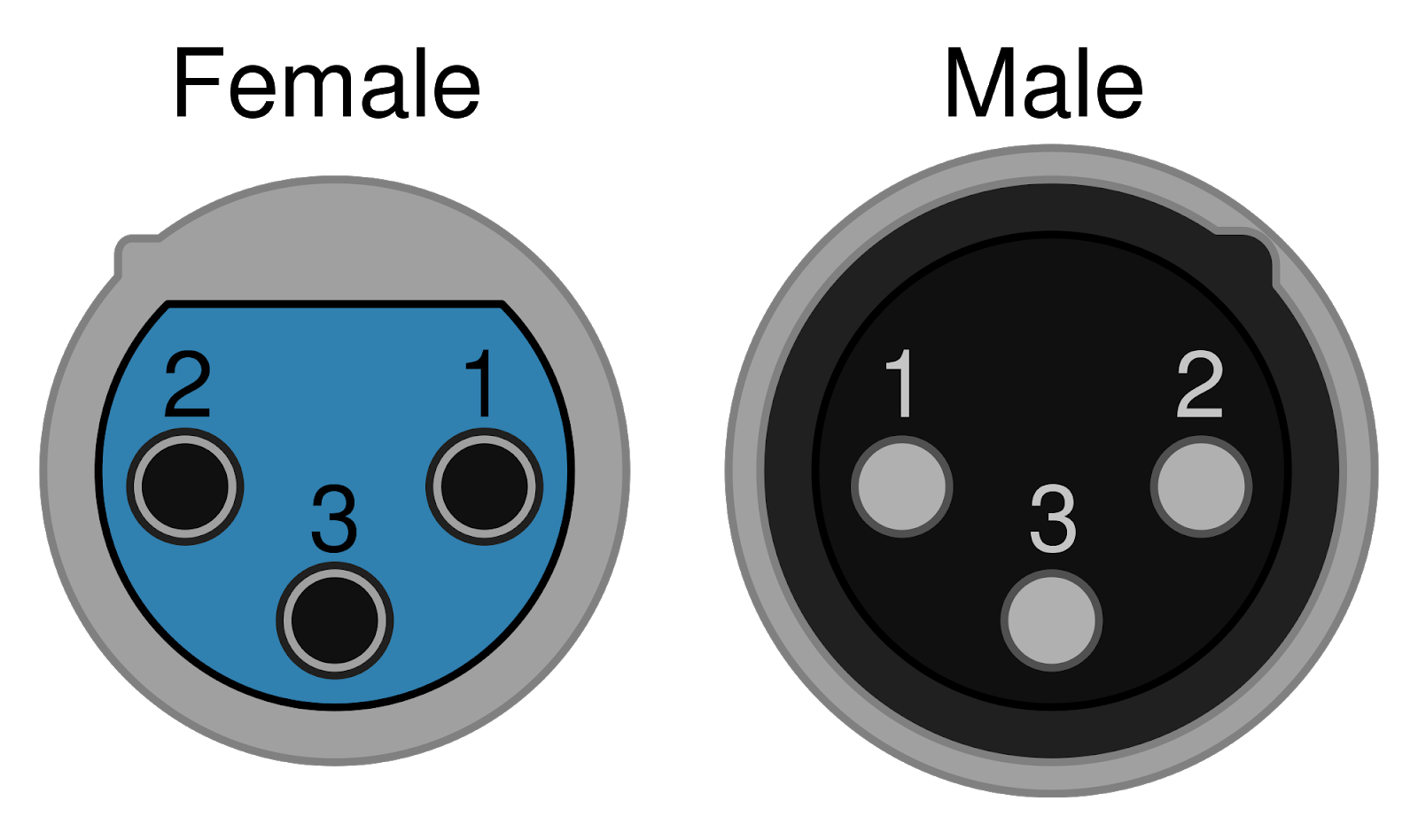
A standard 3-pin XLR connection
While many XLR cables use XLR on both ends, cables that go from XLR to another format are also common. Other popular audio formats such as 3.5mm, RCA, ¼”, and SpeakOn are all compatible with XLR. This makes XLR an ideal choice when connecting devices with varying inputs/outputs.
There is also a downsized version of XLR called Mini XLR. If a device does not have enough space for an XLR port, it may use a Mini XLR port instead. The pin arrangement on a Mini Port is more compressed due to space limitations but keeps the same general shape to maintain functionality between standard XLR and the Mini equivalent.
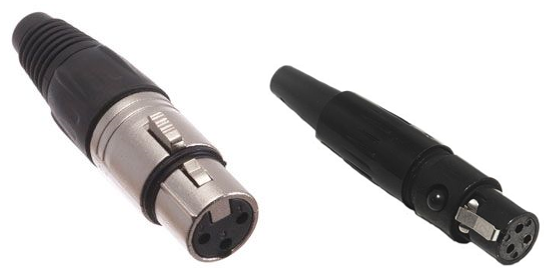
Full-size 3-pin XLR (left) vs. the Mini XLR version (right)
What are DMX Cables?
DMX cables were originally designed using pre-existing XLR technology in the 1980s. The idea behind DMX was to take existing technology and adapt it to lighting systems, which at the time were using older cables that were cumbersome and clunky. On the outside, a DMX connector is identical to an XLR equivalent. The writing printed onto the outside of the cable will say either “DMX” or “XLR” to identify the cable.
Like XLR, the most common version of DMX is the 3-pin version. DMX also has a 5-pin version that is common. Originally, the idea was that a 5-pin connector could function the same as the 3-pin version and then the two extra pins could be used for future upgrades. While there have been attempts to make use of those extra pins over the years, none of those attempts have become industry standard. Due to this similarity, there are DMX adapters that can be used to go from 3-pin to 5-pin or vice versa.
The key difference between 3-pin and 5-pin DMX is the size and layout of the pins. Because the two extra pins on 5-pin DMX are rarely used, many DMX cables on the market today actually leave them unconnected and only wire the main three pins. It should also be noted that 5-pin DMX resembles some 5-pin DIN connectors, particularly the 180° version, but these are not the same and are not interchangeable.
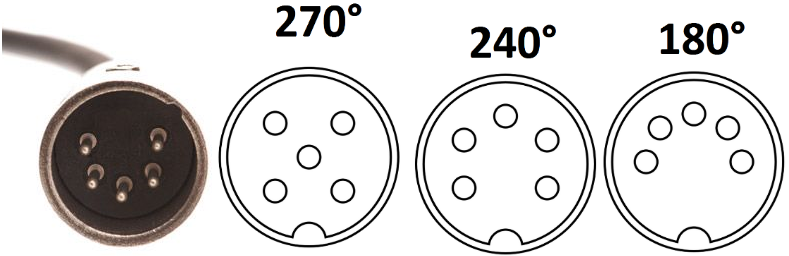
5-pin DMX (left) compared to three different types of 5-pin DIN
Can I Use XLR for DMX?
The difference between XLR and DMX is cable performance. Yes, it is possible (but not advised) to use XLR cables for DMX connections. DMX has a higher impedance (110 ohms) than XLR (75 ohms). This means that XLR uses different signals than DMX is built to handle. An XLR cable can transmit a DMX signal, but not very well. An XLR cable used for this is likely to cause flickering lights or experience signal loss if it even works at all.
Using XLR and DMX together will not damage your equipment, but signal degradation is likely. The odds of degradation, or total signal loss, can also increase based on the distance of the cable, the number of connections used, and how many of those connections are XLR vs. DMX.
ShowMeCables offers both XLR and DMX at various lengths ranging from 1 to 100 feet with custom options available as well. XLR cables are available as either mono or stereo. Our stock includes standard XLR cables as well as units converting to other audio formats including ¼”, 3.5mm, RCA, and SpeakOn.
DMX cables are available in both 3-pin and 5-pin configurations. Both versions are AES/EBU compatible and utilize 110-ohm signals for professional audio cable performance.
Each and every cable is built to federally regulated standards and backed up by warranty. If you have any questions, please contact our Sales team at 1-888-519-9505 or Sales@ShowMeCables.com
Tips for Choosing XLR and DMX Cables
1. Identify the Application
Start by determining whether the cable will be used for audio or lighting/control signals. XLR cables are widely associated with professional audio connections, while DMX is commonly used for controlling stage and entertainment lighting equipment.
2. Check the Connector Type
Inspect the connectors on both pieces of equipment before selecting a cable. XLR connectors are available in different configurations, while DMX equipment can use 3-pin or 5-pin connectors depending on the system.
3. Understand the Difference Between XLR and DMX
XLR refers primarily to a connector family, while DMX refers to a digital lighting-control protocol. A cable having an XLR-style connector does not automatically make it a proper DMX cable.
4. Use the Correct Cable for DMX
For DMX installations, use cable designed for DMX or the applicable RS-485-based electrical requirements rather than assuming any microphone XLR cable will provide equivalent performance.
5. Check Cable Impedance
For DMX applications, cable impedance is an important consideration. Use a cable designed for the required DMX system characteristics to help maintain reliable signal transmission.
6. Check the Number of Pins
Before purchasing a cable, determine whether the equipment uses 3-pin or 5-pin DMX connections. Do not assume the connectors are interchangeable.
7. Consider Cable Length
Plan the complete cable route before selecting the cable length. Avoid unnecessary cable extensions and connection points where possible.
FAQs – Frequently asked questions
What is the difference between XLR and DMX?
XLR is primarily a family of electrical connectors, while DMX is a digital communication protocol used extensively for lighting control. DMX systems commonly use XLR-style connectors.
Is a DMX cable the same as an XLR cable?
No. Although DMX cables can use XLR-style connectors, a DMX cable is designed for the electrical requirements of a digital control signal. A standard microphone XLR cable is not automatically equivalent to a DMX cable.
Can I use an XLR cable for DMX?
It depends on the cable. Some XLR cables may work in certain DMX installations, particularly over shorter runs, but a cable specifically designed for DMX is generally the better choice for reliable system performance.
Can I use a DMX cable for audio?
A DMX cable may physically connect to some XLR audio equipment, but physical compatibility does not necessarily mean it is the appropriate choice for an audio application. Use a cable designed for the intended audio system.
Is DMX analogue or digital?
DMX is a digital control protocol. It is commonly used to transmit control information to stage and entertainment lighting equipment.